


For Further Information Contact:
China: A Brief Discussion on the Customs Challenge System for Export Control of Dual-Use Items
21/07/2025Foreword
With the continuous complex evolution of the international situation, our country’s export control of dual-use items and the strictness of law enforcement in cases of violation of the export control policy of dual-use items are increasing. In practice, cases of violations involving export licenses for dual-use items are basically handled as ordinary cases, and the “two simplified” case procedures are no longer applicable, and the Export Control Law is also applicable to the basis of punishment. This shows that the customs authorities have become more stringent in handling cases involving export licenses for dual-use items, and the penalties have become more severe.
In order to further improve the customs supervision over the export of dual-use items, on June 16 this year, the General Administration of Customs issued the Announcement on Matters Concerning Customs Challenges on the Export Control of Dual-Use Items (GAC Announcement [2025] No. 123, hereinafter referred to as the “Announcement”), which clarifies the responsibilities of the Customs to question and determine whether the exported goods are dual-use items and deal with them accordingly according to the results. This article will briefly introduce the general content of the announcement, analyze the matters that enterprises should pay attention to in the law enforcement practice of this system, and finally briefly provide some compliance ideas for enterprises.
1. What is the customs question about the export control of dual-use items?
As the name suggests, the customs challenge system stipulated in the announcement refers to the power of the customs to question, judge and deal with export goods that may be dual-use items during export supervision. The general points of this system are as follows:
Questioned object: consignor of export goods;
Trigger conditions: failure to submit the inspection permit at the time of export + there is evidence from the customs that the exported goods may fall within the scope of control;
The specific process: Here we use a mind map to show it. It should be noted that during the period of questioning or identification, the customs will not release the relevant goods.
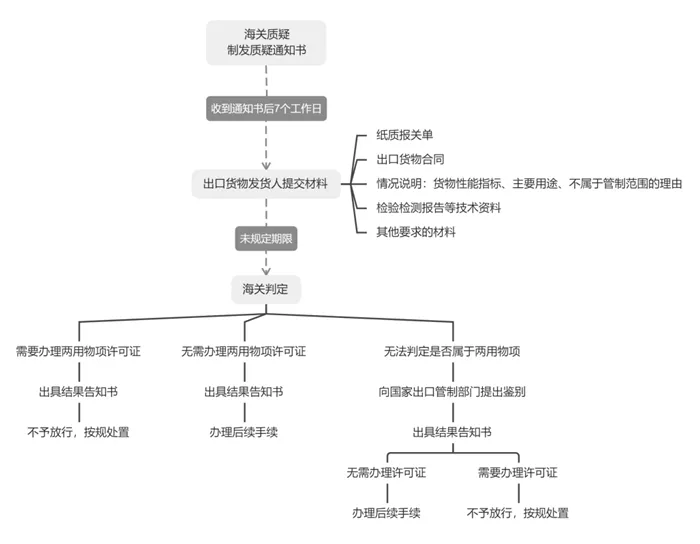
Relief channels: The right to make statements and defenses can be exercised within five working days from the date of delivery of the result notice, and it will be deemed to have been waived after the deadline.
2. What should enterprises pay attention to in the customs challenge system for export control of dual-use items?
Previously, the Export Control Law has stipulated that “if the Customs has evidence that the exported goods may fall within the scope of export control, it shall raise a challenge to the consignor of the exported goods; Customs may submit an organizational appraisal to the SECAD (further specified as “the competent department of commerce under the State Council” in the Regulations on the Export Control of Dual-Use Items), and dispose of it in accordance with the law in accordance with the identification conclusions made by SECAD. During the identification or questioning period, the customs will not release the exported goods“. Based on the basic spirit of the above-mentioned provisions, the announcement further clarifies the practical procedures for customs challenges, and clarifies that when it is not possible to determine whether it is a dual-use item, the customs shall submit an application for identification to the national export control administration, and at the same time give the relevant enterprises certain rights to make statements and defenses.
However, there are still some uncertainties in this system, which may involve the core interests of relevant enterprises, and need to be paid close attention to:
1. Under this system, the Customs is given the power to determine whether the relevant goods are dual-use items to a certain extent. According to the relevant provisions of the Export Control Law and the Regulations on the Export Control of Dual-Use Items, the competent department of commerce of the State Council is the department responsible for the export control of dual-use items, and is responsible for formulating and adjusting the export control list of dual-use items, approving licenses, and responding to inquiries or making identification conclusions on whether they are dual-use items. In other words, the administrative power to determine whether a certain goods are dual-use items is the competent department of commerce under the State Council. The main functions of the Customs in the export control system of dual-use items are to accept and review the export declaration of relevant goods, carry out export inspection of relevant goods, and deal with violations of the export control policy of dual-use items in accordance with the provisions of the Customs Law, which is also reflected in practice. At the same time, although the Export Control Law and the Regulations on the Export Control of Dual-Use Items give Customs the power to raise challenges, they do not give Customs the power to determine whether goods are dual-use items. However, the announcement stipulates that when the relevant goods are exported without submitting the inspection license, and the customs raises a question, the enterprise can determine whether the relevant goods belong to dual-use items or are not dual-use items and carry out follow-up processing, and only when the customs cannot make an accurate judgment will it enter the link of identification by the commerce department, which actually provides a legal basis for the customs to determine whether the relevant goods are dual-use items.
Therefore, in such a legal context, there may be a series of similar situations in which the relevant goods are found not to be required to apply for dual-use items after consulting the commerce department, but are questioned by the customs at the time of actual export and determine that a dual-use item license is required, or the relevant goods are determined to need to apply for a dual-use item license after consulting the Ministry of Commerce, and the customs determines that the dual-use item license is not required and released after being questioned by the customs at the time of actual export. Of course, we can reasonably infer that since the Export Control Law and the Regulations on the Export Control of Dual-Use Items are higher-level laws, the determination opinion of the commerce department should be more authoritative than the judgment of the customs.
2. It is not clear what is the basis and method for the Customs to determine whether the relevant goods are dual-use items. In practice, the determination of dual-use items is an extremely professional, complex and rigorous task, and the Ministry of Commerce has set up a special department and expert group to be responsible for the management and confirmation of dual-use item licenses. In the actual process of law enforcement, some customs use the standard of judging whether the customs commodity number of the relevant goods should be included in the “Catalogue of Dual-Use Items and Technology Import and Export License Administration” as the criterion for judging whether they are dual-use items, but the Ministry of Commerce has clearly replied in the FAQ No. 3 on dual-use items issued by the Ministry of Commerce on the basis of the commodity number: the customs commodity number is not the basis for determining whether the goods are dual-use items, and the judgment of dual-use items must still be based on the attributes of the goods themselves. It is determined in conjunction with the specific rules for dual-use items.
At the same time, the announcement stipulates that one of the prerequisites for initiating the customs challenge procedure is that “the customs has evidence that the exported goods may fall within the scope of export control”. How does the Customs determine that the relevant goods may fall within the scope of export control? Judging from the relevant provisions of the customs declaration form filling specifications, declaration elements and accompanying documents submitted for inspection in accordance with the law, under normal circumstances, the content required by the customs to declare the enterprise in the export link does not involve the detailed technical documents of the relevant goods, so it can be reasonably speculated that the basis for the customs to identify the relevant goods may fall within the scope of export control may also be the customs commodity code of the relevant goods declaration, the declaration elements and the basic description of the product in the export accompanying documents. At the same time, a comprehensive judgment is made based on whether other consignors in the customs records have submitted export licenses for dual-use items when exporting the same or similar goods within a similar period of time. However, such a judgment method may still need to be strengthened in terms of scientific and rigorous.
3. The remedies for questioning or identifying the results are not clear enough, and there is still room for strengthening the remedies. The announcement does not provide a clear remedy for the outcome of the Customs’ challenge, but it is stated in the template of the notification of the result attached to the announcement that the recipient may exercise the right to make a statement and defense within five working days from the date of service of the notice. We believe that when the Customs makes a determination on whether a dual-use item license is required for the relevant goods, or makes a judgment through organizational appraisal, the corresponding judgment results play a decisive role in determining whether the counterparty has violated the law, so it is essentially a type of administrative confirmation. According to the relevant provisions of the Administrative Reconsideration Law, the time limit for reconsideration shall be 60 days from the date of knowing or should have known of the administrative act. However, in this announcement, on the one hand, the Customs only gives a time limit of 5 working days to make statements and defenses, which is significantly shorter than the 60-day time limit for administrative reconsideration, and on the other hand, it does not clearly inform the parties that the corresponding challenges or appraisal results can be remedied by means of administrative reconsideration, nor does it explain how the right to make statements and defenses should be exercised. The remedies of administrative reconsideration are obviously much stronger than simple statements and defenses, and the procedures are more standardized, and this lack of clarity on the remedies may make it impossible for relevant enterprises to accurately seek the most appropriate remedies, and thus fail to fully protect their legitimate interests.
4. It can be reasonably inferred from the text of this announcement that the Customs’ questioning is only for the goods that have not yet been exported, but for those who have been exported, and it is found that the consignor of the export goods has not submitted the inspection license at the time of export during the follow-up inspection, does the Customs still have the right to question or even determine whether the relevant goods are dual-use items? Although it is not clear in the announcement, it does essentially give the customs the power to determine whether the relevant goods are dual-use items. Although in the current law enforcement practice, for unlicensed exports, the Customs still needs to rely on the appraisal opinion of the Ministry of Commerce when determining whether there is a violation of the export control regulations of dual-use items, since the goods have been exported, it is difficult to determine whether the goods are dual-use items in substance. With the issuance of the announcement, the Customs may make its own judgment on this basis, but whether this is an expanded use of the corresponding power still needs to be tested by law enforcement practice, and the relevant rules and supporting law enforcement supervision need to be further clarified.
5. The announcement does not clearly stipulate the specific time limit for the customs to question or identify the results. Since the Export Control Law, the Regulations on the Export Control of Dual-Use Items and this announcement all stipulate that during the identification or challenge period, the customs will not release the relevant export goods, and in the case that the announcement does not stipulate a clear time limit for the customs to make a conclusion, the process of questioning or identification may take a long time, which is extremely unfriendly to the short order delivery cycle, or the transaction involving fragile and depreciable goods, and the economic and legal risks faced by enterprises will also surge.
3. What companies can do to respond
Since the system gives the customs the right to make judgments, but there are still the above-mentioned uncertainties, enterprises need to be extra cautious in the customs declaration process when exporting goods similar to dual-use items, or the same kind of goods with different control standards for different technical parameters, and can consider improving the export work from the following aspects, so as not to cause unnecessary doubts from the customs department:
1. Considering that the main basis for the customs judgment is likely to be the commodity number, before the relevant goods (including parts and spare parts of the goods, etc.) are exported, the enterprise must make an accurate judgment on the classification of the customs commodity number, and determine whether it involves the number listed in the “Catalogue of Dual-use Items and Technology Import and Export License Administration”.
2. In order to respond to possible challenge procedures in a timely manner, enterprises can further judge whether the export goods are consistent with the items in the catalogue or have similarities with the items in the catalogue by referring to the names and descriptions of the items in the Catalogue for the Administration of Import and Export Licenses for Dual-use Items and Technologies, and prepare technical description documents in advance in combination with the description of the items in the catalogue and the actual situation of the exported goods.
3. If there are similarities between the export goods and the items in the catalog, the declaration elements of the goods should be filled in according to the description of the items in the catalog, and the key technical differences between the goods and the items in the catalogue should be clearly reflected.
4. If conditions permit, before the export of goods, especially for transactions with high sensitivity to the time-consuming export process, you can apply to the commerce department for the identification of dual-use items in advance, and upload the identification conclusion to the single window as an accompanying document. In case of any challenge from the Customs, a statement of the situation may be submitted to the Customs, explaining the urgency of the relevant export transactions and requesting the Customs to expedite the processing.
5. In the event of a challenge from the customs, on the one hand, the technical indicators of the goods should be fully explained, and at the same time, the relevant goods should be identified by the commerce department. On the other hand, if there is any doubt about the result of the challenge and needs relief, do not ignore the “hidden” remedy of administrative reconsideration.
All in all, in the context of the increasingly strict national supervision of the export of dual-use items, enterprises should establish a good sense of compliance, establish and improve the company’s export process system, standardize daily export behavior, follow up and learn the new rules and directions of the state on the export control of dual-use items in a timely manner, and make good use of the existing official compliance tools such as the customs classification advance ruling and the Ministry of Commerce’s dual-use item identification consultation, so as to carry out export activities with a prudent and serious attitude, so as to prevent and avoid possible compliance risks to the greatest extent.
Anjie Broad, China, a Transatlantic Law International Affiliated Firm.
For further information or for any assistance please contact china@transatlanticlaw.com
Disclaimer: Transatlantic Law International Limited is a UK registered limited liability company providing international business and legal solutions through its own resources and the expertise of over 105 affiliated independent law firms in over 95 countries worldwide. This article is for background information only and provided in the context of the applicable law when published and does not constitute legal advice and cannot be relied on as such for any matter. Legal advice may be provided subject to the retention of Transatlantic Law International Limited’s services and its governing terms and conditions of service. Transatlantic Law International Limited, based at 84 Brook Street, London W1K 5EH, United Kingdom, is registered with Companies House, Reg Nr. 361484, with its registered address at 83 Cambridge Street, London SW1V 4PS, United Kingdom.